



 Buick Enclave: Tire Sidewall Labeling
Useful information about a tire is molded into its sidewall.
The examples show a typical passenger vehicle tire and a compact spare tire sidewall.
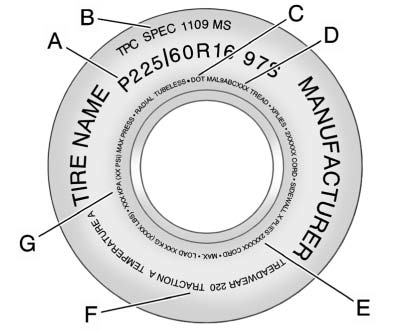
Passenger (P-Metric) Tire Example
(A) Tire Size: The tire size is a combination of letters and numbers used to define a particular tire's width, height, aspect ratio, construction type, and service description. See the “Tire Size” illustration later in this section for more detail.
(B) TPC Spec (Tire Performance Criteria Specification): Original equipment tires designed to GM's specific tire performance criteria have a TPC specification code molded onto the sidewall.
GM's TPC specifications meet or exceed all federal safety guidelines.
(C) DOT (Department of Transportation): The Department of Transportation (DOT) code indicates that the tire is in compliance with the U.S. Department of Transportation Motor Vehicle Safety Standards.
(D) Tire Identification Number (TIN): The letters and numbers following the DOT (Department of Transportation) code are the Tire Identification Number (TIN). The TIN shows the manufacturer and plant code, tire size, and date the tire was manufactured. The TIN is molded onto both sides of the tire, although only one side may have the date of manufacture.
(E) Tire Ply Material: The type of cord and number of plies in the sidewall and under the tread.
(F) Uniform Tire Quality Grading (UTQG): Tire manufacturers are required to grade tires based on three performance factors: treadwear, traction, and temperature resistance. For more information see Uniform Tire Quality Grading
(G) Maximum Cold Inflation Load Limit: Maximum load that can be carried and the maximum pressure needed to support that load.
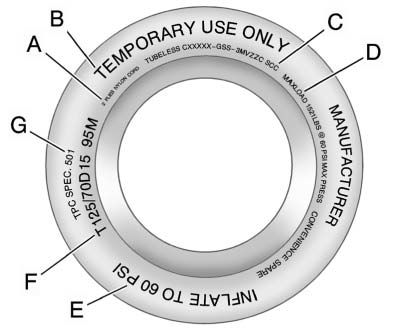
Compact Spare Tire Example
(A) Tire Ply Material: The type of cord and number of plies in the sidewall and under the tread.
(B) Temporary Use Only:
The compact spare tire or temporary use tire has a tread life of approximately 5 000 km (3,000 mi) and should not be driven at speeds over 105 km/h (65 mph). The compact spare tire is for emergency use when a regular road tire has lost air and gone flat. If the vehicle has a compact spare tire, see Compact Spare Tire and If a Tire Goes Flat .
(C) Tire Identification Number (TIN): The letters and numbers following the DOT (Department of Transportation) code are the Tire Identification Number (TIN). The TIN shows the manufacturer and plant code, tire size, and date the tire was manufactured. The TIN is molded onto both sides of the tire, although only one side may have the date of manufacture.
(D) Maximum Cold Inflation Load Limit: Maximum load that can be carried and the maximum pressure needed to support that load.
(E) Tire Inflation: The temporary use tire or compact spare tire should be inflated to 420 kPa (60 psi). For more information on tire pressure and inflation see Tire Pressure .
(F) Tire Size: A combination of letters and numbers define a tire's width, height, aspect ratio, construction type, and service description. The letter T as the first character in the tire size means the tire is for temporary use only.
(G) TPC Spec (Tire Performance Criteria Specification): Original equipment tires designed to GM's specific tire performance criteria have a TPC specification code molded onto the sidewall.
GM's TPC specifications meet or exceed all federal safety guidelines.
 Wheels and Tires
Tires
Every new GM vehicle has high-quality tires made by a leading tire manufacturer.
See the warranty manual for information regarding the tire warranty and where
to get service. For additional ...
 Tire Designations
Tire Size
The following is an example of a typical passenger vehicle tire size.
(A) Passenger (P-Metric) Tire:
The United States version of a metric tire sizing system.
The letter P as the first ...
See also:
Turn signal switch
1 Turn signal
Move the lever up or down to signal the
turning direction. When the turn is completed,
the turn signals cancel automatically.
2 Lane change signal
To indicate a lane change, ...
Ventilators
Center ventilators
Open/close the ventilators by moving the
control to either direction.
: This symbol indicates that the
ventilators are
closed. Moving the side control to this
direct ...
Folding the exterior mirrors in or outelectrically
► Make sure that the SmartKey is in
position
1 or 2 in the ignition lock.
► Briefly press button 1.
Both exterior mirrors fold in or out.
Make sure that the exterior mirrors are ...


