



 Range Rover: Rear head restraints
 WARNING
Adjust the head restraint so that the top of the head restraint is above the center line of the head. An incorrectly adjusted head restraint increases the risk of death or serious injury in the event of a collision or sudden stop.
WARNING
Do not drive or carry passengers with the head restraint removed from an occupied seat. The absence of a correctly adjusted head restraint increases the risk of neck injury in the event of a collision or sudden stop.
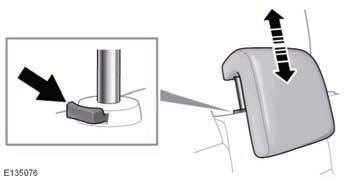
To adjust:
- • Press the locking button on the collar.
- • Raise or lower the head restraint until the top of the restraint is level with the top of the passenger’s head.
To remove:
- • Press the locking button on the collar.
- • Lift the head restraint out of the seat.
WARNING
Always store a removed restraint securely.
To refit:
- • Ensure the head restraint is facing the correct direction.
- • Insert the stems of the restraint into the sockets on the seatback.
 Front head restraints
WARNING
Head restraints are designed to support the head not the back of the neck. The
head restraint must be positioned correctly to restrain rearward movement of the
head in a collision.
...
 Steering wheel
...
See also:
Phone
Bluetooth
For vehicles equipped with Bluetooth capability, the system can interact with
many cell phones, allowing:
Placement and receipt of calls in a hands-free mode.
Sharing of the cell pho ...
Remote key fob transmitter locations
1. Cabin front transmitter.
2. Keyless start module.
3. Front exterior door handle transmitters.
4. Rear exterior door handle transmitters.
5. Cabin headlining transmitter.
6. Loadspace interio ...
Rear-facing child restraint installation using LATCH
Refer to all Warnings and Cautions in the
“Child safety” and “Child restraints” sections
before installing a child restraint.
Follow these steps to install a rear-facing
child restrain ...


