



 Range Rover: Lashing points
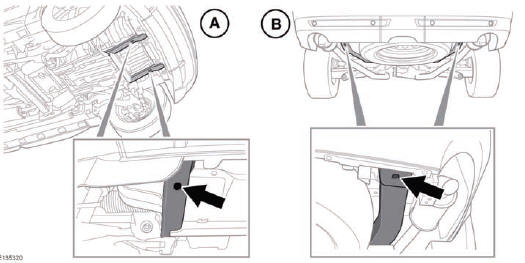
A. Front lashing points.
B. Rear lashing points.
 WARNING
The front and rear lashing points must be used only securing the vehicle during transportation. If they are used for any other purpose, it may result in vehicle damage and serious injury.
Note: The front and rear lashing points are for lashing only and must not be used for towing.
The two pairs of lashing points on the underside of the vehicle are provided for the insertion of appropriate hooks.
 NOTICE
Do not secure lashing hooks to any other part of the vehicle.
 Rear towing point
The rear towing point is located behind a removal panel in the lower rear bumper.
The rear towing point may be used to tow another vehicle if required.
1. Rotate each of the fasteners 90 degrees ...
 Transporting the vehicle
Recovery by trailer is the recommended method for transporting the vehicle. Always
use qualified persons to perform recovery and to ensure the vehicle is secured correctly.
WARNING
Use extrem ...
See also:
Speaker Covers
Vacuum around a speaker cover gently, so that the speaker will not be damaged.
Clean spots with just water and mild soap. ...
What Will You See after an Airbag Inflates?
After the frontal airbags and seat-mounted side impact airbags inflate, they
quickly deflate, so quickly that some people may not even realize an airbag inflated.
Roof-rail airbags may still be at ...
Malfunction Indicator Lamp
► computer system called OBD II (On-Board Diagnostics-Second Generation) monitors
the operation of the vehicle to ensure emissions are at acceptable levels, to produce
a cleaner environment. ...


