



 Mercedes-Benz GL-Class: Front air bags
The front air bags increase protection for the driver's and front-passenger's head and chest.
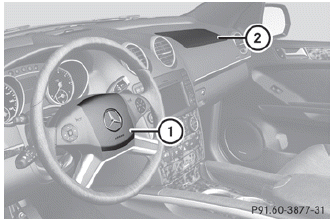
Driver's air bag 1 deploys in front of the steering wheel; front-passenger front air bag 2 deploys in front of and above the glove box.
They are deployed:
• in the event of certain frontal
impacts
• if the system determines that air bag
deployment can offer additional protection
to that provided by the seat belt
• if the seat belt is fastened
• independently of other air bags in the
vehicle
If the vehicle overturns, the front air bags are generally not deployed unless the system detects high vehicle deceleration in a longitudinal direction.
Your vehicle has adaptive, two-stage front air bags. In the event of a collision, the air bag control unit evaluates the vehicle deceleration. In the first deployment stage, the front air bag is filled with enough propellant gas to reduce the risk of injuries.
The front air bag is fully deployed if a second deployment threshold is exceeded within a few milliseconds.
Vehicles with OCS (USA only): deployment of the front-passenger front air bag is also influenced by the weight category of the front passenger, which is determined by the Occupant Classification System (OCS).
Vehicles with OCS (USA only): the lighter the passenger side occupant, the higher the vehicle deceleration rate required (predicted at the start of the impact) for second stage inflation of the front-passenger front air bag.
In the second stage, the front air bags are inflated with the maximum amount of propellant gas available.
The front air bags are not deployed in situations where a low impact severity is predicted. You will then be protected by the fastened seat belt.
 Vehicles with BabySmart™ (Canada only):
do not place any objects which weigh more than 20 lb (9 kg) on the front-passenger seat. This could cause the system to identify the seat as being occupied. In the event of an accident, the restraint systems on the front-passenger side are triggered.
Have restraint systems that have been triggered replaced.
The front-passenger front air bag will only deploy if:
• the system, based on the OCS weight sensor readings, detects that the frontpassenger seat is occupied (USA only).
• the
 indicator lamp in the
center console is not lit, USA:
indicator lamp in the
center console is not lit, USA:
Canada:
the  indicator lamp in the
center console is not lit.
indicator lamp in the
center console is not lit.
• the air bag control unit predicts a high impact severity.
 Important safety notes
WARNING
Air bags are designed to reduce the incidence
of injuries and fatalities in certain situations:
• frontal impacts (driver's and
frontpassenger
front air bags and driver's k ...
 Driver's knee bag
Driver's knee bag 1 provides additional
protection for the driver against:
• knee injuries
• thigh injuries
• lower leg injuries
Driver's knee bag 1 deploys below the
steering wheel. Dur ...
See also:
Environmental Concerns
Always use established trails, roads, and areas that have been set aside
for public off-road recreational driving and obey all posted regulations.
Do not damage shrubs, flowers, trees, or grass ...
Braking in Emergencies
ABS allows the driver to steer and brake at the same time. In many emergencies,
steering can help more than even the very best braking. ...
Recommended Fuel
Use regular unleaded gasoline with a posted octane rating of 87 or higher. If
the octane rating is less than 87, an audible knocking noise, commonly referred
to as spark knock, might be heard when ...


