



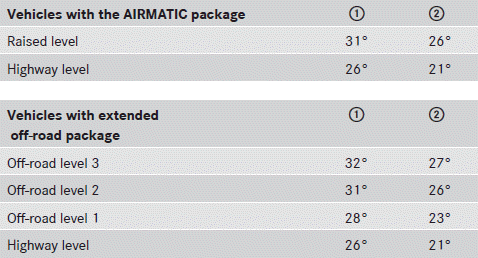
 Mercedes-Benz GL-Class: Approach/departure angle
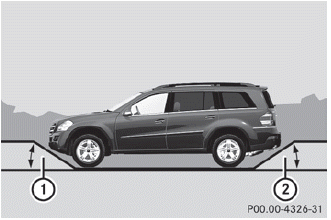
1 Approach/departure angle, front
2 Approach/departure angle, rear
• Comply with the rules for off-road
driving.
• Do not drive at an angle on slopes,
inclines or gradients, but instead follow the direct line
of fall. The maximum gradient-climbing capability of your vehicle is 100%, which
corresponds
to an approach/departure angle of 45°. Note that the vehicle's gradient-climbing
capability
depends on the off-road conditions.
• Before tackling steep downhill gradients,
select shift range 1.
• Drive slowly.
• Avoid high engine speeds – drive at a
suitable engine speed (maximum 3000 rpm).
• Use the braking power of the engine when
driving down a slope. Observe the engine speed,
do not overrev the engine.
• Check the brakes after driving off-road for
a long time.
WARNING 
Never turn the vehicle around on steep inclines. The vehicle might roll over. If
the vehicle cannot
complete the attempted climb, back it down in reverse gear.
 Hill start assist will aid you when pulling away on a hill.
For more information, see "Hill start assist".
 Traveling uphill
...
 Maximum gradient-climbing capability
For good road surface conditions, the
maximum gradient-climbing capability is
100%, which corresponds to an approach/
departure angle of 45°. Note that the
vehicle's gradient-climbing capability
...
See also:
Warning/indicator lights and audible reminders
...
FCC Information
See Radio Frequency Statement for information regarding Part 15
of the Federal Communications Commission (FCC) rules and Industry Canada Standards
RSS-GEN/210/220/310.
Frequency of oper ...
Storing Radio Station Presets
To set preset radio stations, do the following:
1. Press to turn the system on.
2. Press AUDIO and select the desired band (AM, FM, or XM (if equipped)).
3. Use the (tuning) knob,
, or
(Seek) ...


