



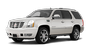
 Cadillac Escalade: If the Vehicle Is Stuck
Slowly and cautiously spin the wheels to free the vehicle when stuck in sand, mud, ice, or snow. See “Rocking Your Vehicle to Get It Out” later in this section.
If the vehicle has a traction system, it can often help to free a stuck vehicle. Refer to the vehicle's traction system in the Index. If stuck too severely for the traction system to free the vehicle, turn the traction system off and use the rocking method.
 WARNING
If the vehicle's tires spin at high speed, they can explode, and you or others could be injured. The vehicle can overheat, causing an engine compartment fire or other damage. Spin the wheels as little as possible and avoid going above 56 km/h (35 mph).
For information about using tire chains on the vehicle, see Tire Chains .
 Blizzard Conditions
Being stuck in snow can be a serious situation. Stay with the vehicle unless
there is help nearby. If possible, use the Roadside Service (U.S. and Canada) or Roadside Service (Mexico)&nbs ...
 Rocking Your Vehicle to Get It Out
Turn the steering wheel left and right to clear the area around the front wheels.
Turn off any traction or stability system. Shift back and forth between R (Reverse)
and a forward gear, spinning the ...
See also:
Entering the Feature Settings Menu
1. Turn the ignition on and place the vehicle in P (Park). To avoid excessive
drain on the battery, it is recommended that the headlamps are turned off.
2. Press the customization button to scroll t ...
Notes on driving
• If the vehicle is heavily laden, check
the tire
pressures and correct them if necessary.
• When parking your vehicle, make sure that
the tires do not get deformed by the curb
or other obst ...
Switching on Blind Spot Assist
► Make sure that the radar sensor system and Blind Spot Assist are activated in the on-board
computer.
► Turn the SmartKey to position 2 in the
ignition lock.
Warning lamps 1 light u ...


