



 Range Rover: Child seats
According to crash statistics, children are safer when properly restrained in the rear seats than in the front seat. The air bags alone will not prevent children from being seriously injured or killed. Never place a child in any type of child restraint or booster seat in the front passenger seat. Children under the age of 13 should always ride in the rear.
Make sure the child seat fits your child properly. Always check the seat manufacturer’s instructions and labels for height and weight limits. For more specific guidance, consult your pediatrician. There are three general types of child restraint systems: Infant seats, toddler seats, and belt-positioning booster seats.
Infants: at least 1 year of age and at least 20 lbs (9 kg).
Toddlers: until about age 4 and about 40 lbs (18 kg).
Boosters: belt-positioning booster until about age 8 or at least 4 ft ins (145 cm) and seat belt fits properly.
 DANGER
Do not allow a baby or infant to be held or carried on the lap. The force of a crash can increase effective body weight by as much as thirty times, making it impossible to hold onto the child. At all times, children should be restrained in age and size appropriate child seats to reduce the risk of death or serious injury in a crash.
 WARNING
Children could be endangered in a crash if their child restraints are not properly secured in the vehicle. Always follow the instructions that accompany the child seat carefully.
Child restraint systems are designed to be secured in vehicle seats by use of the lap belts or the lap belt portion of a lap-shoulder belt. Children could be endangered in a crash if their child restraints are not properly secured.
The seat belts fitted to your vehicle are designed for adults and larger children. It is very important for all infants and children to be restrained in a suitable child safety seat appropriate to their age and size.
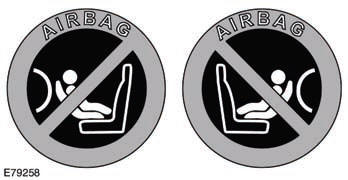
This symbol, affixed to the end of the facia on the passenger side, warns against the use of a rear-facing child seat in the front passenger seat, when a front passenger air bag is fitted and operational.
If it is essential that a child travels in the front passenger seat, Land Rover recommends that the following preparations are made before fitting the child restraint.
- • Adjust the front passenger seat fully rearwards.
- • Adjust the lumbar support to its minimum support position.
- • Adjust the seat cushion to its highest position. If cushion rake adjustment is possible, adjust it to its lowest position.
- • Adjust the seat back to the fully upright position.
- • Adjust the seat belt adjustable upper anchorage to its lowest position.
WARNING
Extreme hazard! Never place a rearward facing child restraint on the front passenger seat. The infant could be serious injured or killed if the air bag deploys.
 Child safety locks
If children are to be carried in the rear seat positions, it is recommended that
the rear door interior handles are disabled.
See 27, USING SEAT BELTS AND CHILD SAFETY LOCKS. ...
 Child restraint check list
Every time a child travels in the vehicle observe the following:-
Non-LATCH child restraints
• Carefully follow the instructions provided by the manufacturer of the
restraint system.
• A ...
See also:
Removing the detachable tow hitch
Removal of the tow hitch is the reverse of fitting.
Note: The key cannot be removed when the tow hitch has been detached. ...
Securing Child Restraints (Rear Seat Position)
When securing a child restraint in a rear seating position, study the instructions
that came with the child restraint to make sure it is compatible with this vehicle.
If the child restraint has the ...
Menu options
The start menu can be displayed using the
menu control switch on the steering-wheelmounted
controls.
1. While the MAP or STATUS screen is
displayed, push and hold the menu
control switch u ...


